
The label & them
There has been growing discussion in the press and on social media platforms about diagnoses & labelling and whether these labels are accurate/relevant/necessary/misguided/supportive or restrictive. It’s a confusing landscape but is in many ways hopeful because it reflects a growing desire for understanding and therefore support. Dyslexia was recognized in 1887 first as an ocular condition for ‘word blindness’, and over the following years understanding evolved to recognition of it as a neurological disorder and later still, not as a ‘disorder’ but as a neurobiological learning difference. The understanding of neurodiversity, which is full of argument and discussion at the moment but is without doubt a loud and prevalent societal conversation, is provoking systemic questions and therefore potential change. There is no doubt, that in this community, this conversation pertains to the vast majority & is interesting to follow and perhaps contribute to. However, the single most important thing in amongst all this noise, whether positive or negative, is to remember to look at, to keep ‘seeing’ our children beyond all the labels & diagnoses and keep in touch with THEM. Keep being open to who they are, their observations, interests, questions, in essence their humanity & potential. They are, as we are, their own particular human that is so much bigger & more complex than any diagnosis. So often we can get lost in the idea of them being a problem, having a problem, trying to understand the problem that our perspective becomes skewed. Perhaps we don’t approach them as though we might value their opinion, perhaps we don’t give enough space and time to really listen, for companionship, as though their thoughts and insights really matter. In our worry and exhaustion, anger, frustration, we can lose sight of our children as whole, unique souls. When we subliminally or overtly interact with them from a position of brokenness or limitation we can unwittingly reduce them to something only to be fixed.
‘The heart of man’s pain is the pain of not being seen.’ – Unknown
Two recent perspectives on autism:
An article by Uta Frith, who is emeritus professor in cognitive development at the Institute of Cognitive Neuroscience at University College London (UCL), and the person who pioneered much of the research that underpins our current understanding of autism
https://www.tes.com/magazine/teaching-learning/general/uta-frith-interview-autism-not-spectrum
And this is a response to Frith’s perspectives from Professor Tony Attwood (www.attwoodandgarnettevents.com), a current leading specialist in Autism.
https://www.attwoodandgarnettevents.com/blogs/news/prof-uta-frith-s-interview-what-do-we-think
What these articles highlight is both the importance of scientific and medical evaluation and understanding but at the same time the fact that, as we pointed out above, we as parents are uniquely positioned to be able to respond to and really know our own child’s particular humanity, to nurture the person beyond the diagnosis.
To Read
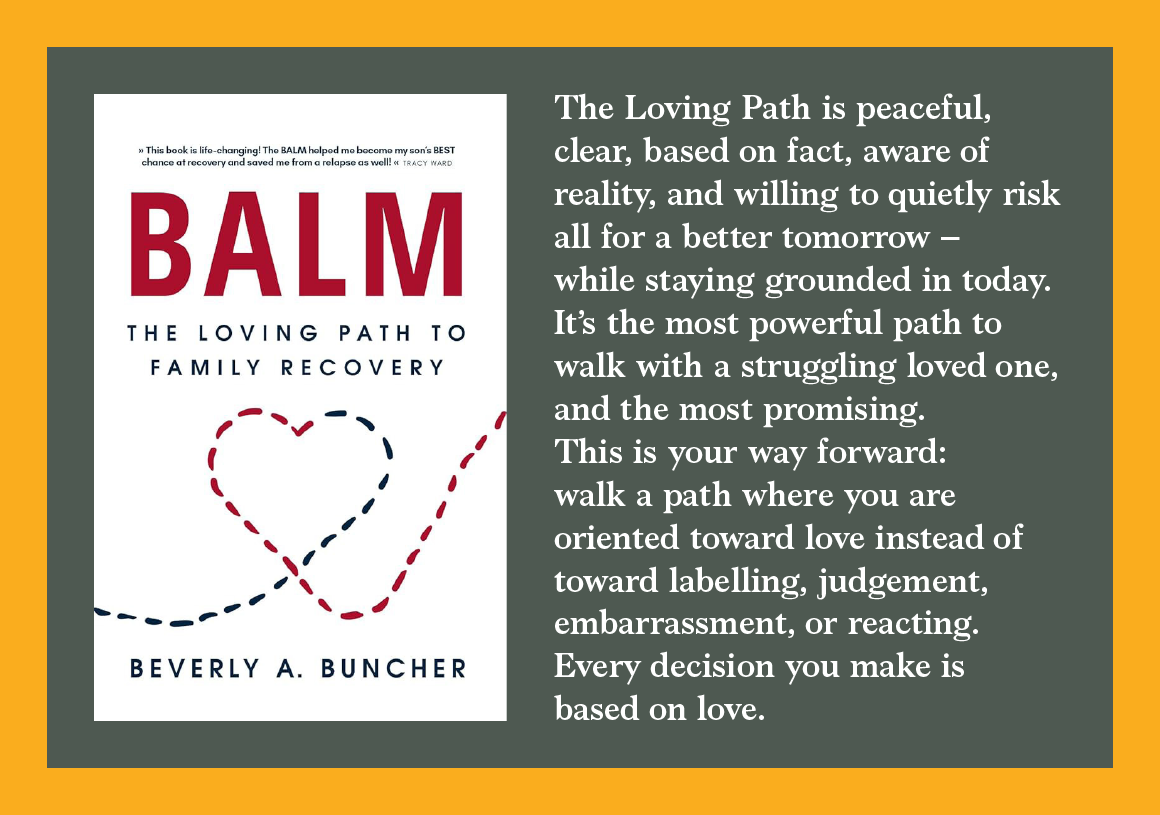
This is a lovely quote, expanding on the above thoughts, from the book, BALM: The Loving Path to Family Recovery, by Beverley Buncher

To Watch
On the same theme, a film to watch is the recent BAFTA winning I Swear, telling the true story of the life of Tourette’s sufferer John Davidson. It’s a very moving film about the impact of this condition and what can happen when you have someone who champions, sees and walks alongside you. This is available to rent on Amazon Prime.

In-person meeting dates in London
As always, would be lovely to see anyone who can make it and who would like to gather for coffee, chatter and connection:
12th March at 10.30 am @ Carluccio’s in South Kensington SW7 3HZ
16th April at 10.30 am @ COTE Brasserie, St Christophers Place, Marylebone W1U 1ND
March Speaker
Wednesday 18th March at 6.30pm
Steve Carter, Yes We Can coach & counsellor
“How do I choose me AND us?”
Both as a parent and as a partner how do we navigate this delicate line between choosing and maintaining our own lives whilst also loving and supporting our loved ones, especially when in crisis or when we feel they may be making choices, holding beliefs, displaying behaviours that challenge us.
Now available to watch: https://we-thrive.org.uk/how-do-we-choose-me-and-us
April Talk
Wednesday 22nd April at 6.30pm
Parent talk
Liz Toomer will talk to us about her learnings from her experience with her eldest son’s challenges (including ADHD & addiction), considering the impact on siblings, the adjustments to family life, reflections on treatment, communication & boundaries.